Physical language
A compact discrete representation of world-state transitions learned at scale from unlabeled in-the-wild videos.

 A World Model Built Around Physical Language
A world model that explicitly reasons about world evolution in physical language before rendering the inferred transitions into video.

Humans abstract predictive structure from visual experience and organize it in natural language for explicit reasoning. Because natural language is too coarse for complex physical transitions, PhiZero learns a finer-grained physical language directly from in-the-wild videos.
We introduce PhiZero, a world model built around physical language: a compact discrete representation of world-state transitions learned from unlabeled in-the-wild videos through self-supervision. PhiZero follows a reason-then-render paradigm: it first infers future world evolution as a physical-language sequence, then renders the inferred transitions into video.
A compact discrete representation of world-state transitions learned at scale from unlabeled in-the-wild videos.
An autoregressive VLM predicts a physical-language sequence from the current visual state and action intent; a trained diffusion decoder renders the inferred transition into video.
The same transition representation supports physically realistic generation, fine-grained action-conditioned simulation, interactive rollouts, and zero-shot transfer.
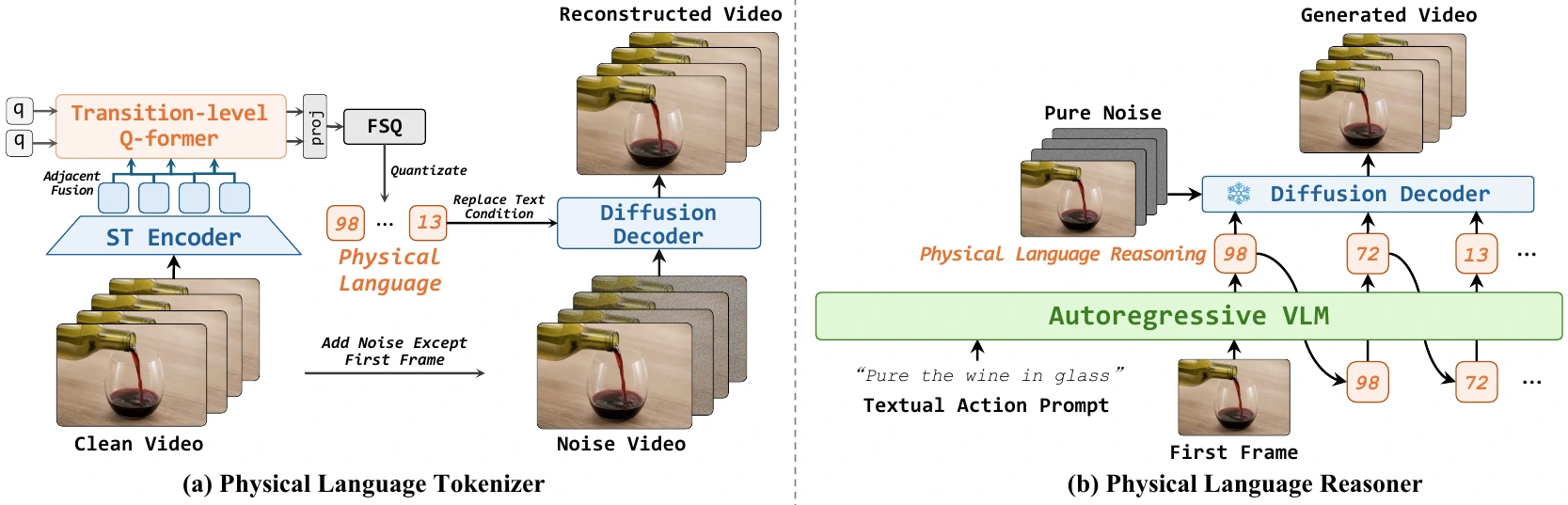
A transition-level Q-Former extracts ordered features from adjacent latent video states. FSQ discretizes them into physical language, while a diffusion-prior decoder reconstructs the video from that sequence and the clean first frame.
A Qwen3-VL-4B-initialized autoregressive VLM predicts a physical-language sequence from the first frame and textual action intent. The trained diffusion decoder then renders the inferred state transition into a future video.
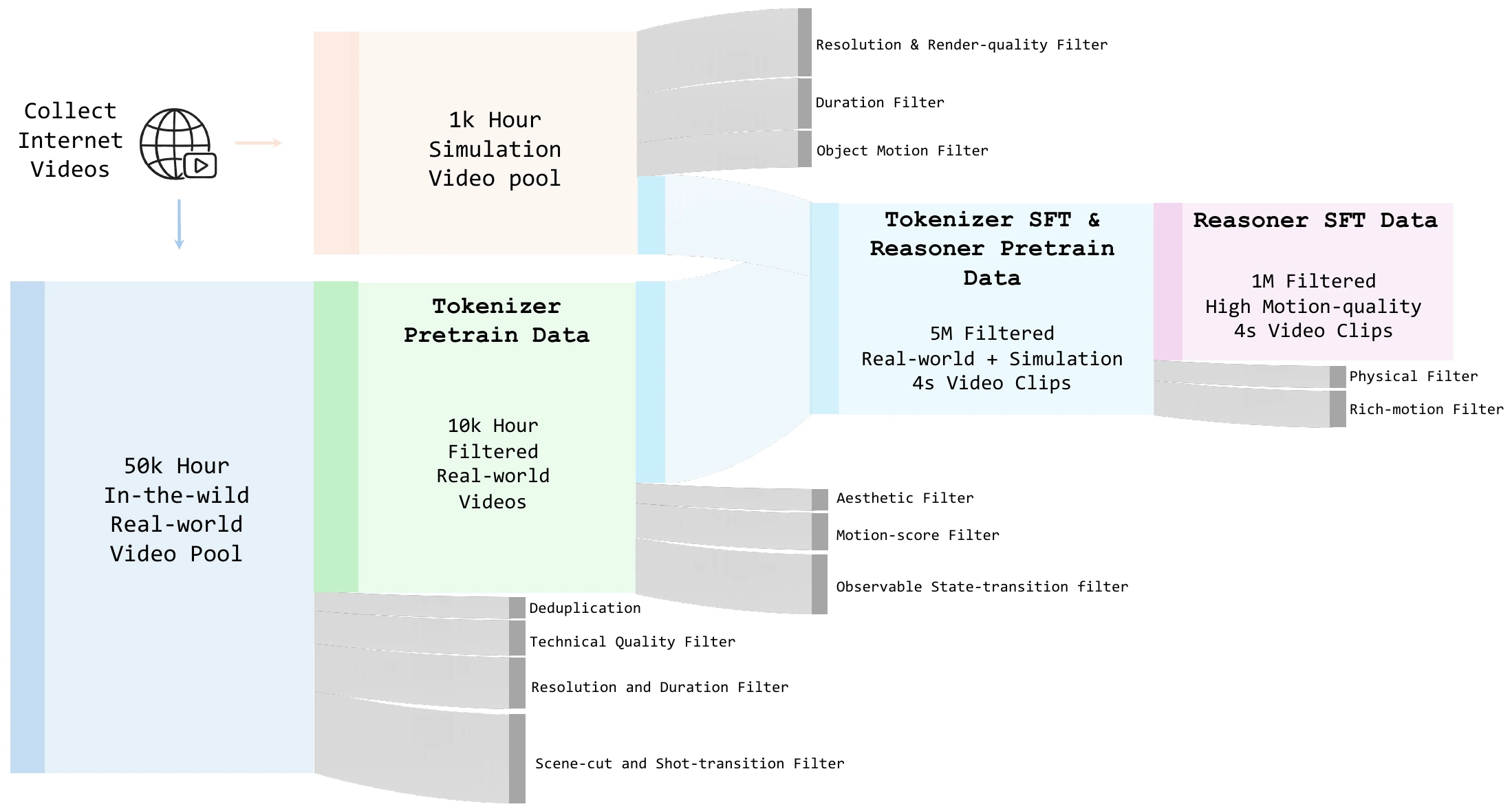
Progressive filtering turns a 50K-hour in-the-wild real-world pool into 10K hours for tokenizer pretraining. Real and simulated videos yield 5M four-second clips for tokenizer SFT and reasoner pretraining, followed by 1M motion-rich and physically informative clips for reasoner SFT.
| Model | IQ-Score ↑ |
|---|---|
| Wan2.2-5B | 21.2 |
| Sora 2 | 26.5 |
| Cosmos3-Nano | 29.1 |
| Wan2.2-14B | 32.2 |
| Hunyuan-Video | 33.4 |
| Grok-Video | 34.8 |
| Cosmos3-Super | 39.5 |
| PhiZero (Ours) | 41.2 |
| Model | Physics Score ↑ |
|---|---|
| LTX-Video-19B | 2.54 |
| LTX-Video-22B | 2.56 |
| Wan2.2-5B | 2.65 |
| Cosmos2.5-2B | 2.70 |
| OmniWeaving | 2.78 |
| Veo3.1 | 2.85 |
| Wan2.2-14B | 2.90 |
| PhiZero (Ours) | 3.01 |
| Model | Physics Adherence ↑ |
|---|---|
| Pandora | 4.05 |
| OpenSora-Plan | 3.85 |
| CogVideoX | 3.88 |
| Mochi | 4.14 |
| Luma | 4.13 |
| Wan2.2-5B | 4.51 |
| Runway | 4.27 |
| PhiZero (Ours) | 4.88 |
| Model | Overall ↑ |
|---|---|
| Cosmos-4B | 49.41 |
| Qwen2.5-VL | 52.27 |
| Gemini-1.5 Pro | 52.27 |
| GPT-4o | 53.75 |
| VideoMAEv2 | 53.75 |
| V-JEPA | 53.75 |
| Gemini-2.5 Flash | 55.63 |
| PhiZero (Ours) | 56.34 |
Across the four displayed benchmarks, PhiZero leads the selected physical metric: IQ-Score, Physics Score, Physics Adherence, and IntPhys2 Overall. The results support both physically coherent generation and intuitive physics understanding.
Prompt 01 A brown tennis ball rolls straight out of a black pipe across a light beige coffee table and strikes a small yellow rubber duck, with a mustard couch visible behind the table, with the camera held in a fixed close view.
Prompt 02 A blue-black grabber holds a blue tennis ball over a mound of green kinetic sand on a wooden table, then releases the ball into the soft pile, with clear colors and minimal background clutter.
Prompt 03 A yellow tennis ball rolls from a black pipe onto a simple cardboard ramp propped by a blue block on a light wooden table against a plain wall, in a bright indoor tabletop setup.
Prompt 04 A row of colorful wooden blocks stands on a wooden table beside a black platform, where a rotating wooden stick swings clockwise and knocks the first block, with clear colors and minimal background clutter.
Prompt 05 A yellow mug and a blue rectangular block rotate together around the center of a black platform while a spotlight projects their large shadows onto the wall, with the camera held in a fixed close view.
Prompt 06 A clear acrylic box suspended from an orange cord lowers over a tennis ball with a smiley face on a wooden table, covering it from view, with the camera held in a fixed close view.
Prompt 07 A tennis ball hanging in front of a mirror is slowly lowered, while the mirror creates a second reflected ball beside it in the frame, with the camera held in a fixed close view.
A four-second, 33-frame video is encoded with 256 discrete physical-language symbols, compared with 44,800 continuous tokens for the Wan2.2 VAE, while retaining strong reconstruction quality among highly compressed tokenizers.
TL;DR: We introduce PhiZero, a physical world model that learns a compact discrete physical language from in-the-wild videos. It reasons world evolution in this space and renders the inferred transitions into videos, enabling physically realistic and interactive world modeling, fine-grained action-conditioned simulation, and zero-shot motion transfer.
Explore physically realistic video generation, cross-embodiment transfer, sim-to-real transfer, interactive world models, and fine-grained world simulation.
Because physical language encodes how the world changes rather than how it looks, the same transition can be rendered with a new object, scene, embodiment, or visual domain.
PhiZero first tokenizes a source transition into a discrete physical-language sequence that describes how the state changes. It then combines that sequence with an edited or newly selected first frame, allowing the video decoder to render the same transition under a new object, appearance, material, or embodiment.
The Human → G1 humanoid, Human hand → Sharpa dexterous hand, and Simulation → reality demos above use the same recipe: reuse the source physical language while replacing the visual state from which the transition is rendered.
The current manuscript is available as a preprint. Public ArXiv and code links can be activated from the site configuration as soon as they are released.
Shuyao Shang, Yuqi Wang, Ruopeng Gao, Xu Chen, Tieniu Tan, Lue Fan, Zhaoxiang Zhang
Open PDF ↗@article{shang2026phizero,
title = {PhiZero: A World Model Built Around
Physical Language},
author = {Shang, Shuyao and Wang, Yuqi and
Gao, Ruopeng and Chen, Xu and Tan, Tieniu and
Fan, Lue and Zhang, Zhaoxiang},
year = {2026},
note = {Preprint}
}